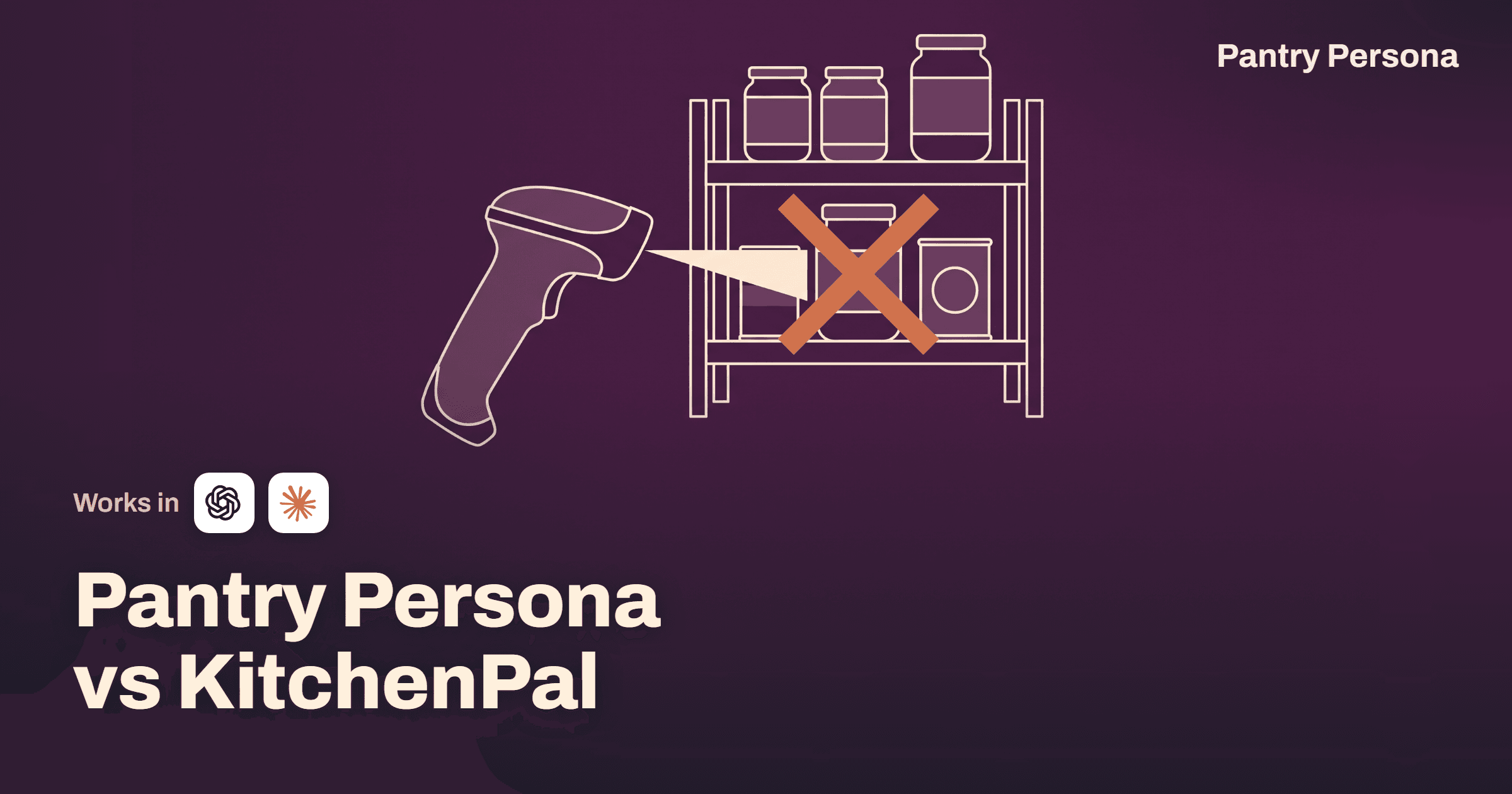
Pantry Persona vs KitchenPal: Scan Every Can, or Just Say It?
Kevin
TL;DR
- KitchenPal is a scanner-first pantry tracker. Its site puts the barcode catalog at more than 5 million products, it keeps the fridge, freezer, and garage as separate sections, and you can buy it once for $29.99 instead of renting it.
- Pantry Persona, which we make, records food as a sentence inside ChatGPT or Claude, or from a photo of your receipt. Mark a recipe cooked and its ingredients come back out.
- Both build a shopping list that skips what you already own, so the difference is how food gets in. KitchenPal keeps data export behind Premium, and Pantry Persona includes it free.
- Both have a free tier. KitchenPal's Premium runs $3.99 a month, $14.99 a year, or $29.99 once, and Pantry Persona's Pro is $7.99 a month or $79.99 a year. Prices read off each app's own site on September 9, 2026.
Quick picks
- Least typing if you already use ChatGPT or Claude: Pantry Persona
- Own the tracker outright: KitchenPal, $29.99 once
- Recording a whole grocery trip in one step: Pantry Persona, from a receipt photo
- Free tier with no cap on pantry items: Pantry Persona
- Keeping the garage freezer as its own shelf: KitchenPal
Four bags on the counter, and the scanner is waiting for you to hold each box up to the camera. You get through the cereal, the pasta and the beans before the phone rings, and the last two bags go into the cupboard unrecorded. Three weeks later the app still believes you own a jar of red curry paste that went into a Tuesday dinner nobody logged.
Both apps hold a list well. They differ on the two moments that decide whether it is still true in November: how food gets in, and who takes it out after dinner.
How did we check these apps?
Every KitchenPal figure came from kitchenpalapp.com, its own FAQ pages, or its US App Store listing, read on September 9, 2026. Pantry Persona claims come from our own product documentation.
Several unrelated businesses use a version of the KitchenPal name. The one compared here is at kitchenpalapp.com, published by iCuisto.
Why does a pantry list stop being accurate?
Because keeping one accurate is a daily logging habit, and logging habits decay even in people who signed up specifically to keep them. That has little to do with willpower and less to do with which app you picked. Anything that needs you to stop and record something, right when your hands are full, ends up the same way.
A 2013 pilot trial measured how fast that decay happens, and whether the tool changes it. Carter and colleagues randomized 128 adults into three ways of logging their food for six months: a smartphone app, a website, or a paper diary. The app group recorded a mean of 92 days, the website group 35, and the diary group 29. Recording declined over time in all three, and by month six only 7 of the 43 app users were still logging daily (Carter et al., 2013). These were volunteers who had signed up to log and knew they were being measured. Nobody is checking in on your Thursday grocery run.
A wrong list costs you at the register and again at the bin. The EPA puts the national scale plainly: over one-third of the food produced in the United States is never eaten, and wasted food is the most common material in American landfills, at 24 percent, and in incinerators, at 22 percent (From Farm to Kitchen, EPA, 2021). Some of that waste is spinach that went from the crisper drawer to the bin without ever reaching a plate.
Every pantry app is accurate the day you set it up. What matters is what it says on the Thursday after the week you skipped.
How do Pantry Persona and KitchenPal compare?
The split is entry and subtraction: getting food in, and taking it back out again. Saying a sentence is less work than capturing one item at a time, and that is the only judgment call we are making.
| Pantry Persona | KitchenPal | |
|---|---|---|
| How food gets in | A sentence in chat, voice on a paid Claude plan, or a receipt photo | Barcode scan, camera detection, voice input, or typing |
| Expiry alerts | Yes | Yes |
| Recipes | Your own library, from a URL, or video links on Pro | Millions of recipes, your own uploads, Paprika and RecipeKeeper imports |
| Meal plan | 7 days free, 30 days on Pro, from recipes you saved | Weekly planner |
| Shopping list | Subtracts the pantry, adds only the difference | Excludes what is already in inventory |
| Household | Shared pantry for 2 free; 2 profiles free, 8 on Pro | Shared inventory and lists, per-person profiles |
| Platforms | ChatGPT, Claude, web dashboard | iOS, Android, web |
| Data export | Free tier | Premium |
| Price, read September 9, 2026 | Free; Pro $7.99/mo or $79.99/yr | Free; $3.99/mo, $14.99/yr, $29.99 lifetime, $39.99 family lifetime |
What does KitchenPal do well?
Storage is where KitchenPal puts its detail. It keeps separate sections for the pantry, fridge, freezer, bar, garage, and cleaning supplies. That means the chest freezer in the garage gets its own shelf instead of disappearing into one list with the pasta.
Entry is broader than the barcode reputation suggests. Its site describes a scanner covering more than 5 million products, and it takes an external Bluetooth scanner if you have one. You can also dictate an item, type it, or point the camera at produce and let the app identify it. Around that sit quantity tracking, leftovers, low-stock notifications, and expiry alerts.
The recipe side matches against what you have and filters for keto, low-FODMAP, vegan, and gluten-free eaters. It takes your own uploads, and it imports whole libraries out of Paprika and RecipeKeeper, which is a thoughtful thing to build for switchers. Sharing syncs inventory and lists in real time, and each person gets a dietary profile with allergy tracking. Its US App Store listing shows 4.5 out of 5 from 614 ratings.
How much does KitchenPal cost?
There is a free tier. Premium is $3.99 a month or $14.99 a year, and you can buy it outright for $29.99, with a family lifetime license at $39.99. Prices vary by country, per its own site. That $29.99 is the interesting figure: many pantry apps rent themselves to you forever, and paying once for a tool you might still use in ten years is a real argument.
Where does KitchenPal leave the work to you?
KitchenPal leaves the work at the entry step. Getting food in is a per-item action inside the app: hold the box up, point the camera, dictate, or type. That works on a Sunday stocking trip and gets much harder on the Tuesday you got home at seven carrying everything at once.
On KitchenPal a grocery trip is a series of captures: the loose apples and the bulk bin rice each need their own. Pantry Persona takes one receipt photo for the whole trip, which matters most on the night nobody feels like standing at the counter with a phone.
What does Pantry Persona do differently?
Pantry Persona moves the entry step into a conversation you were going to have anyway. You say "I bought chicken thighs, milk, and eggs" inside ChatGPT or Claude and that is recorded. You say you had the chicken tonight and it comes off. Ask what you can make and the answer is built from what is on the shelf right now.
A receipt photo does the same for a whole trip. Pantry Persona adds the items, matches them against what is already in your pantry, estimates when they expire, and checks off anything from that trip sitting on your shopping list. Mark a recipe cooked and its ingredients come out of your pantry, scaled to the servings you made. The pantry corrects itself, so it does not need a Sunday clean-up to stay right.
Planning then works from the recipes you saved. It favors what is on hand and steers away from what you ate last week, and the list it builds subtracts what is already in your pantry, adding only the difference. On a paid Claude plan you can record the groceries and plan the week by voice, while you are still carrying bags.
The free tier has no cap on pantry items and room for 100 recipes. Receipt scanning is on it, and so is sharing the pantry with one other person. Pro is $7.99 a month or $79.99 a year after a 7-day free trial, and it stretches planning to 30 days and profiles to eight. Video recipe import and per-recipe nutrition sit there too.
Should you pick KitchenPal or Pantry Persona?
Pick KitchenPal if you want to own the tool outright. At $29.99 once, the subscription question goes away. It also suits a cupboard of packaged goods, a garage freezer you need tracked on its own, and a recipe library you are moving out of Paprika or RecipeKeeper.
Pick Pantry Persona if ChatGPT or Claude is already open when you think about dinner. Saying what you bought beats recording it item by item, especially when half the basket is produce and deli. It also fits two people who need the same list without either of you paying.
The wider field is laid out in the best pantry inventory apps in 2026. For the loyalty-account approach, where groceries appear without anyone recording them, there is Pantry Persona vs Cooklist. The receipt route is broken down in receipt scanning for your pantry.
Common questions about KitchenPal and Pantry Persona
Is KitchenPal free?
Yes, there is a free tier, and Premium starts at $3.99 a month. Data export sits on the Premium side, worth knowing before you build a large inventory for free. Prices vary by country, per KitchenPal's own site.
What is the best free pantry inventory app?
Pantry Persona's free tier puts no cap on pantry items and holds 100 recipes. Receipt scanning, 7-day planning and sharing with one other person are all on it. KitchenPal's free tier is the one to pick if you want barcode scanning, multiple storage locations and expiry alerts without paying.
What is the best AI pantry tracker?
Pantry Persona, if what you want from AI is that it does the recording rather than reminding you to. Saying what you bought puts it in, saying what you cooked takes it out, and asking what to make reads from the shelf as it stands tonight. KitchenPal uses AI for camera detection and voice input, which speeds up the capture step without removing it.
Does Pantry Persona scan barcodes?
Pantry Persona gets food in three ways: a sentence in chat, voice on a paid Claude plan, and a photo of your receipt. Those cover the produce and deli items a barcode cannot reach. If scanning a shelf of tins is how you want to build an inventory, KitchenPal is built for exactly that.
Do both apps work on Android and iPhone?
KitchenPal publishes iOS and Android apps plus a web version. Pantry Persona runs inside the ChatGPT and Claude apps, which are on both platforms, and it has a web dashboard of its own. You install it from the ChatGPT plugins directory or from Claude's connector directory, free accounts included.
How does KitchenPal compare to Pantry Check?
Pantry Check adds items by barcode or photo, and its own site leads with the scanner and the inventory. KitchenPal matches recipes against your inventory and plans a week around them. Pantry Check is free for up to 200 items with storage subscriptions from $1.99 on its App Store listing, and its Android version is sold separately from the iOS one, while KitchenPal publishes both.
Start with the night you would skip
Counting features on a good day settles nothing. Picture the worst realistic evening of your month, hands full, dinner already late, and ask which entry step you would still complete. If the answer is holding boxes up to a scanner, KitchenPal is built for that, down to a separate section for the garage freezer. If it is saying a sentence on the way past the counter, connect Pantry Persona to the ChatGPT or Claude account you already have. Free ChatGPT and Claude accounts both work. Then judge whichever you choose on the Thursday you did not feel like logging anything.