Two Diets, One Household, Zero Arguments
Pantry Persona
TL;DR
- Cooking for a household with mixed dietary needs means mentally cross-referencing every ingredient against every person, every night.
- Generic AI suggestions ignore the complexity. They'll recommend parmesan to a dairy-free kid and casseroles to a child who won't eat mixed foods.
- Persistent household profiles let your AI do the cross-referencing for you and suggest meals that work for everyone at the table.
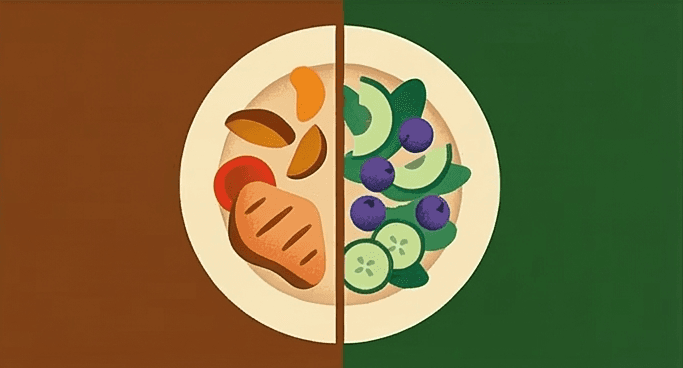
- The key concept: deconstructable meals (where one cooking session produces separate components that plate differently for each person), so you're not making three separate dinners.
Jenna doesn't cook three separate dinners. She can't. There aren't enough hours, pans, or patience for that. But she also can't cook one dinner, because "one dinner" doesn't exist in a household where Olivia can't have dairy, Ben won't eat anything where the foods touch, and David will happily eat whatever shows up.
So every night, Jenna solves a small optimization problem. What can she make that splits cleanly into plates that work for everyone? And she solves it in her head, while also working, while also remembering that the broccoli needs to get used tonight, while also answering the question that arrives like clockwork at 5:15: "What's for dinner?"
Meet the Mitchells
The nightly cross-reference
Jenna finds a recipe for chicken fajitas. Sounds good. She starts running the checklist. Sour cream? Not for Olivia. Cheese? Not for Olivia. The marinade has yogurt in it. That's dairy too. So the whole marinade needs to change, or Olivia gets plain chicken while everyone else gets the good version.
Then there's Ben. Fajitas are mixed by nature. Peppers, onions, chicken, all jumbled in a tortilla. Ben won't eat that. He needs the chicken on one side, peppers somewhere else, and a plain tortilla on its own.
David? David's fine. David is always fine.
This is the invisible work: the mental simulation that happens before the cooking even starts. For every potential meal, Jenna runs it through a filter for each person. Can Olivia eat it? Will Ben eat it? Does it mean making a completely separate dish for someone? That filter runs silently, automatically, and it's exhausting.
The coordination load of satisfying everyone simultaneously turns every meal into a negotiation. The hard part is running each potential meal through every person's filter at once.
Why generic suggestions make it worse
When Jenna asks her AI assistant for help, the conversation usually goes like this: she describes what's in the fridge, asks for a dinner idea, and gets something reasonable but wrong. A cheesy baked pasta. A one-pot chicken and rice casserole. A stir-fry with a cream-based sauce.
The AI is making uninformed suggestions. It doesn't know about Olivia's restriction, Ben's texture preferences, or that Jenna made pasta two days ago.
So Jenna types more. "Olivia can't have dairy. Ben needs his food separated. We had pasta on Monday. I need something in 30 minutes." By the time she's finished entering context, she's spent as much energy prompting the AI as she would have spent figuring it out herself. And tomorrow, she'll have to type it all again. Every conversation is a blank slate.
What profile-aware suggestions look like
Now imagine the AI already knows, with none of the re-explaining, because her household profiles are stored and accessible across conversations.
Searched available tools ›
 Pantry Personashow_profiles
Based on your pantry and your household profiles, here's an idea: Sheet pan chicken thighs with roasted bell peppers and sweet potatoes. About 30 minutes total.
Olivia: completely dairy-free as-is. The seasoning is olive oil, garlic, and paprika.
Ben: serve the chicken, sweet potato, and peppers in separate sections on his plate. Everything cooks on one pan but plates individually.
Everyone else: serve it all together, or over rice if you want a bigger meal.
One pan and one cooking session, with no dairy for Olivia and Ben's food kept apart on his plate. You also have broccoli that's been in the fridge since Monday. Want me to add that to the sheet pan to use it up?
The suggestion arrived pre-filtered. No dairy in any component, the meal deconstructs naturally for Ben, and the ingredients match what's already in the fridge. Jenna didn't specify any of that.
That's what persistent profiles change. The cross-referencing that happens in Jenna's head shifts to the AI. It won't work for every meal. But enough that the 5pm question becomes a conversation instead of a logic puzzle.
The deconstructable meal trick
Experienced multi-diet cooks already know this trick, even if they don't have a name for it. You build meals from components that work together on one plate or separately on another. Tacos, bowl meals, sheet pan dinners (everything on one pan, into the oven). Anything where the protein and vegetables can land in the same pan but serve independently.
The problem is that this strategy lives entirely in the cook's head. Recipe databases don't tag meals as "deconstructable." Search engines don't understand "dinner that works for a dairy-free kid and a picky eater at the same table." That's household-specific knowledge, and until recently, no tool could hold it.
When your AI has persistent access to household profiles, it can apply this filter automatically. It knows which family members need components separated and which ingredients violate someone's restriction. It can tell the difference between a meal that plates individually and one that doesn't. Jenna still decides what to make. But the narrowing-down happens faster when she's not the only one doing the math.
The same approach works for households navigating dietary restrictions from health conditions, cultural or religious food practices, or just different taste preferences across generations.
Over time, the benefit compounds, because your saved recipes and ratings build up a history the AI can reference. The Mitchells' collection fills up with deconstructable meals that worked, and those get suggested first. Jenna rates the roasted sweet potatoes a 5 for Ben but the mashed version a 2, and future suggestions reflect that. Olivia's dairy-free wins get saved, so the AI stops reaching for substitution-heavy recipes. Wednesday's schedule is in the household profile. None of that requires new technology. It just requires memory, and a place to keep it.
Feeding a mixed household is real work
If you're the person in your house running this nightly calculation, you already know it's harder than it sounds. One restriction is manageable. Two restrictions with a picky eater and a busy schedule? That's a coordination problem, and it deserves tools that actually understand the constraints.
Pantry Persona holds each family member's dietary profile alongside your pantry and meal history. The cross-referencing you've been doing in your head, your AI handles it from the first suggestion. If you're curious what that looks like day-to-day, we walked through a full week of real scenarios with the same family.