What Your Grocery Receipt Knows About You
Pantry Persona
TL;DR
- Three months of grocery receipts can reveal your household size, health conditions, income bracket, stress levels, and major life events.
- Target famously identified a pregnant teenager from her purchase patterns before her family knew. That was 2012. The algorithms are better now.
- The same data that makes you profiled also makes you informed. The difference is who controls it.
- Your food data is uniquely intimate because everyone eats, every day, and the patterns are hard to fake.
A single grocery receipt. Chicken thighs, rice, broccoli, almond milk, prenatal vitamins, ginger ale, saltines. To the cashier, it's $47.83. To an algorithm, it's a profile.
That receipt says someone is probably pregnant, eats a moderately healthy diet, and is watching their budget. Add three months of receipts and the picture fills in fast. Household of two, based on portion sizes. Likely first pregnancy, because prenatal vitamins just appeared for the first time. Mild morning sickness, given six weeks of ginger ale and saltines bought together. A preference for cooking at home over eating out.
Nobody told the algorithm any of this. The receipts did.
What three months of purchase history reveals
Grocery data is weirdly personal. No single purchase matters much on its own. But the patterns across dozens of trips paint a picture that's hard to look away from.
Household size. Buying two chicken breasts? Probably a couple. Family packs of ground beef? Four or more people. The math is simple and the data is consistent week after week.
Health conditions. Gluten-free bread, lactose-free milk, sugar-free snacks. Specialized products map to specific conditions. A sudden shift to low-sodium foods could mean a new diagnosis. Medications that end up on pharmacy-attached grocery receipts fill in whatever's left.
Income signals. Store brand everything? Name brand everything? The ratio between the two stays remarkably stable for any given household, and it tracks closely with income bracket. A shift from name brand to store brand often signals a financial change before any bank statement does.
Stress and mental health. This one is subtle but documented. When takeout frequency spikes, when prepared meals replace raw ingredients, when grocery trips get smaller and more erratic, the data tells a story about what's happening in someone's life. A 2015 study from the University of Minnesota found that convenience food purchases correlated with self-reported stress levels more reliably than most survey instruments.
Life events. Baby products appearing for the first time. Pet food on a receipt from someone who never bought it before. Flowers every Friday for eight weeks. Alcohol purchases doubling over a period of months. These are timestamps.
Cultural and religious identity. Halal or kosher products, specific spices associated with regional cuisines, holiday-specific purchases. Your grocery store knows what you celebrate and roughly where your family is from.
Nobody told the algorithm any of this. The receipts did.
The Target story, and what came after
In 2012, a man walked into a Target store in Minneapolis and demanded to know why his teenage daughter was receiving coupons for baby clothes and cribs. The store apologized. A few days later, the man called back to apologize himself. His daughter was, in fact, pregnant.
Target's data science team had built a "pregnancy prediction score" from purchase patterns. About 25 products, when bought together in certain combinations, predicted pregnancy with high accuracy. Unscented lotion, zinc and magnesium supplements, cotton balls, hand sanitizer, washcloths. None of them are "baby products." All of them, together, form a signal.
That was thirteen years ago. The analytical tools were primitive compared to what exists today. Target was working with purchase history from a loyalty card and basic statistical models. Modern systems ingest credit card data, location history, app usage, browsing behavior, and purchase records across multiple retailers at the same time. The pregnancy prediction model from 2012 would be a homework assignment for a junior data analyst in 2026.
Who actually has your grocery data
More entities than you'd think.
Your grocery store's loyalty card tracks every purchase and ties it to your identity. Your credit card company sees the transaction amounts and merchants. If you use a grocery delivery app, the app has your complete item-level purchase history plus your address, delivery schedule, and browsing behavior. What you looked at but didn't buy is its own data stream.
Then there's the secondary market. Data brokers buy purchase data from multiple sources, link it to your identity across platforms, and sell the combined profile to anyone who'll pay. A 2024 report from Duke University's Technology Policy Lab found that data brokers routinely sell consumer profiles that include grocery purchase patterns, often without meaningful consent mechanisms.
Most people don't think about this because the data feels mundane. It's groceries. But mundane, repeated, unavoidable data is exactly the kind that builds the most accurate profiles. You can opt out of social media. You can't opt out of eating.
When the same data works for you
Everything that makes food data sensitive also makes it useful. The purchase patterns that let a retailer profile you can help you understand your own habits, if you're the one looking at them.
Three months of receipts show your actual spending patterns, not what you think you spend. They show which items you buy on autopilot and which ones you deliberate over. They predict when you'll run out of something based on how fast you go through it. They surface the gap between what you say you eat and what you actually buy.
That information is worth something to you, too. If you knew you buy cilantro every two weeks and throw half of it away, you'd buy less or use it faster. If you could see that your takeout spending doubles in the last week of every month, you could plan around it.
The question is whether you get to see any of this. Most of the time, the answer is no. The retailer sees it. The data broker sees it. The brand that paid for a targeted ad sees it. You get a long receipt and a vague sense that you overspent.
Got it, 23 items added to your pantry. A few things that jumped out:
You bought olive oil again. Last bottle was 18 days ago, so you're going through it faster than usual. The chicken thighs expire in 3 days, so plan to use them by Thursday. And you've bought ginger ale three weeks in a row now. Want me to add it as a staple so it shows up on your list automatically?
Your grocery spending this month is $312 across 4 trips, about $40 under your typical pace.
That's what it looks like when the data works for you. Your own purchase patterns, surfaced to help you plan instead of packaged and sold to help someone else target you.
Why food data deserves more scrutiny
We've gotten used to the idea that tech companies know a lot about us. Browsing history, location data, social media activity. Food data occupies a different category. It's biological. Everyone eats, every day, multiple times a day. The purchases are hard to fake and the patterns are hard to break. You can use a VPN, but you can't disguise the fact that you buy diapers.
Food data also touches health in ways that other consumer data doesn't. A grocery profile can infer probable medical conditions, dietary restrictions, pregnancy status, and mental health patterns. That's a real privacy concern in a country where health insurance isn't universal and preexisting conditions carry financial consequences.
Your receipt tells a story. You should be the one reading it.
Your grocery receipt knows your household size, your health, your stress levels, your budget, and your life events. That data exists whether you think about it or not. The question is whether it flows to a data broker who sells it for ad targeting, or back to you in a form that actually helps you eat and spend better.
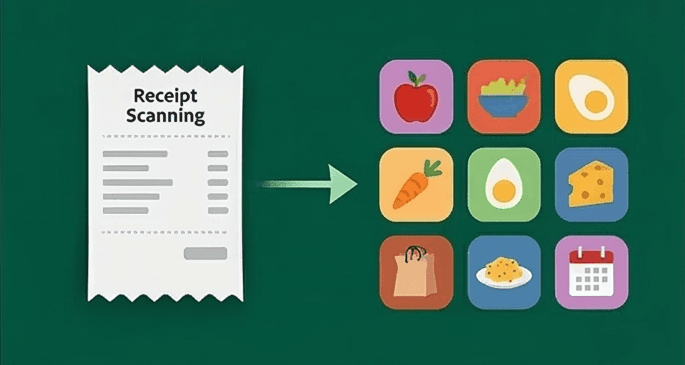
We built Pantry Persona around a specific idea: your food data should serve you, not a brand's ad budget. When you scan a receipt, the data populates your pantry and informs your meal planning. It doesn't get sold, shared, or brokered. For the full breakdown of how we handle kitchen data, read Your Kitchen Data Belongs to You.
If you're curious about what receipt scanning looks like in practice, here's how it turns your phone into a pantry. And if you want to see what happens when your AI actually learns from what you've been buying, we wrote about that too.