The ADHD Kitchen: Four Executive Functions Dinner Demands, and How to Offload Them
Pantry Persona
TL;DR
- Dinner defeats executive dysfunction because it asks for four skills at once, and they are the four ADHD disrupts: working memory, task initiation, time estimation, and sequential processing
- The way out is to stop holding those four jobs in your head. Put the pantry, the diets, and the saved recipes somewhere your AI assistant can read, then ask one question and cook the answer
- Most meal planning advice assumes you already have the executive function it's trying to replace
- This is not medical advice. If you think you have ADHD, talk to a professional
You know what you want for dinner. Sort of. You thought about it this morning. You had a plan, or the beginning of one. But then you got a text, and the dog needed out, and you remembered a work thing, and now it's 6pm and the thought is gone. Not forgotten, exactly. More like it fell behind the couch of your brain, and you don't have the energy to go looking for it.
If that sounds familiar, you're not lazy and you're not bad at cooking. You might just be trying to do a task that's specifically designed to be hard for the way your brain works.
What meal planning actually asks of your brain
Break down what goes into planning a single dinner tonight.
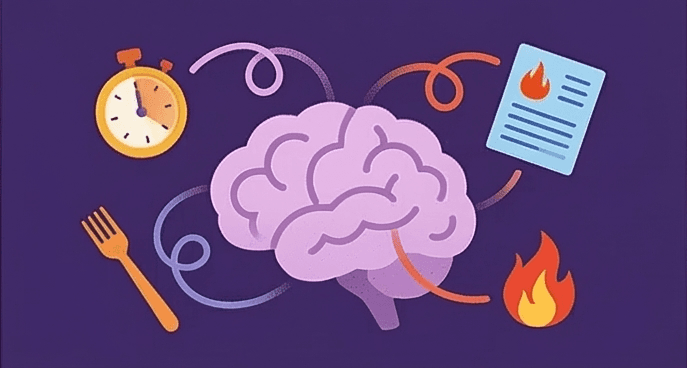
You need to remember what's in the fridge without looking (working memory). You need to start the process of deciding before you're already starving (task initiation). You need to estimate whether that recipe actually takes 30 minutes or more like 55 (time estimation). And you need to hold the sequence together: defrost, chop, preheat, cook, in the right order, without losing your place (sequential processing).
Those four skills have something in common. According to CHADD (Children and Adults with Attention Deficit/Hyperactivity Disorder), they're all executive functions, and they're all areas where ADHD brains struggle reliably, regardless of motivation or effort.
This isn't a willpower problem. Executive function differences in ADHD are neurological, well-documented in research, and present even when motivation is high. ADDitude Magazine has published extensively on how executive dysfunction affects daily living skills, and cooking comes up again and again as a pain point.
So when meal planning feels unreasonably hard, it's because for your brain, it is harder. The difficulty is real.
Why "just meal prep on Sunday" doesn't work
You've heard the advice. Spend two hours on Sunday, prep everything, line up your containers, and coast through the week.
That advice assumes you can initiate a two-hour task on a day when nothing is externally forcing you to start. It assumes you can estimate how long each recipe takes and sequence the prep work so the rice finishes when the chicken does. It assumes your working memory will hold the full inventory of what you prepped by Wednesday night.
The standard meal planning advice assumes you already have the executive function it's trying to replace. That's the catch.
It's like telling someone with a broken leg to walk it off. The prescription requires the thing that's missing.
This isn't an argument against meal prep. Plenty of people with ADHD find routines that work for them, sometimes with support, sometimes through years of trial and error. But the breezy "just plan ahead" framing ignores why planning ahead is the hard part in the first place. A version of that routine built around an ADHD brain rather than against it is laid out in Meal Planning With ADHD.
What happens when you reduce the decisions
The worst moment isn't cooking. Cooking can actually be enjoyable once you're moving. The worst moment is the gap between "I need to figure out dinner" and "okay, I'm making this." That gap is where executive function gets tested hardest, and where ADHD brains tend to stall.
That gap shrinks when your AI assistant already knows your kitchen:
Searched available tools ›
 Pantry Personashow_recipes
You've got chicken thighs, broccoli, and soy sauce in the pantry. How about a one-pan chicken and broccoli stir-fry? 20 minutes, one cutting board, one pan. I can walk you through each step when you're ready.
You didn't browse. You didn't take inventory. You didn't open four tabs of recipes and get lost comparing them. The AI already knows what you have, what you've eaten this week, and who you're cooking for. You asked one question and got one answer.
That's fewer decisions between you and dinner.
Externalized executive function
The clinical term for what tools like calendars, reminders, and checklists do is "externalized executive function." You take the process that your brain struggles to manage internally and put it somewhere outside your head.
People with ADHD have been doing this forever. Alarms for transitions. Visual timers for cooking. Sticky notes on the door. These are accommodations, and they work.
Pantry Persona does something similar for the kitchen. It holds your pantry inventory, your household's dietary needs, your saved recipes, and your meal plan in one place that your AI assistant can access. The context that would otherwise need to live in your working memory, which is exactly the memory system that ADHD affects, gets held externally instead.
You still choose what to eat. You still cook. But the part that requires you to hold six variables in your head simultaneously while also initiating the task while also estimating the time? That part gets quieter.
The dinner question, reconsidered
You have ADHD, or you suspect you do, or you love someone who does. And every night, dinner happens whether your executive function showed up or not.
A kitchen app doesn't fix ADHD. But for the specific problem of too many dinner decisions hitting a brain that's already maxed out, having an AI that remembers your kitchen is one more accommodation in the toolbox. Medication, routines, a supportive partner: those matter too. If someone else is in the kitchen with you, splitting the dinner load on purpose beats splitting it by default. This just makes the food part a little lighter.
See if it works for your brain | Read more: The 5pm Panic
This article is for informational purposes only and does not constitute medical advice. ADHD is a neurodevelopmental condition best diagnosed and treated by qualified healthcare professionals.