How to Share the Mental Load of Dinner With Your Partner
Pantry Persona
TL;DR
- Dinner is hard to hand off because most of the job is knowledge, and the knowledge sits in one person's memory where nobody else can open it.
- Researchers who study household labor break the thinking work into four parts: anticipating needs, finding options, deciding, and keeping track. Couples split the deciding fairly evenly, and the anticipating and keeping track stay with one person.
- "Just tell me what to make" moves the smallest part of the job. The asking still routes through the person holding everything else, so a real offer of help can land as more work.
- A handoff works when the context is written down somewhere both people can reach: what is in the kitchen, who eats what, and which nights are already spoken for.
- Pantry Persona holds that context inside ChatGPT and Claude, and a two-person household can share it on the free plan, so the answer does not have to come from one person's memory.
Wednesday, 4:40pm. Someone in the house says, I can cook tonight, just tell me what to make. Answering that takes four separate facts: the chicken needs using, Thursday is already pasta so tonight cannot be, one kid will eat peppers only if they are not touching anything else, and the recipe is saved in a text thread from March. By the time the answer is said out loud, the planning is finished, and none of it was cooking.
Doing this job alone is a subject of its own, and we made that case at length in You're Not Bad at Meal Planning. This piece is about the question that comes after it: what has to change before a second person can take a real piece of dinner.
Why is dinner so hard to hand off?
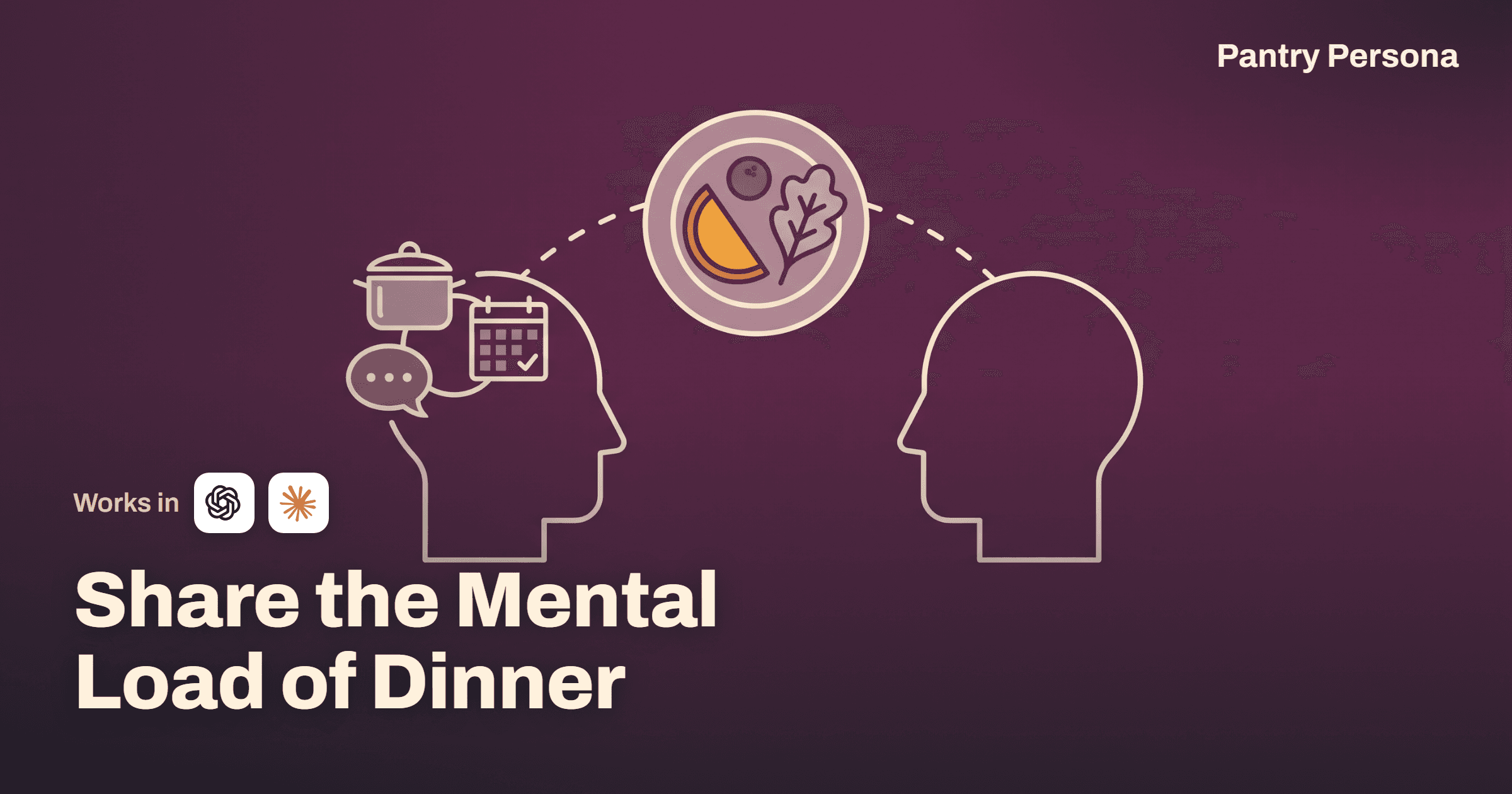
Because the job is mostly knowledge, and the knowledge is not written down. Handing off a task means handing off the task's context, and the context for dinner is a live model of the fridge, the week, and every eater in the house. That model lives in one person's memory, so it travels with them and stops at the edge of their head.
Sociologist Allison Daminger interviewed 70 people across 35 couples and found that the non-physical side of running a household has a consistent shape. She calls it cognitive labor, and it breaks into four moves: anticipating needs, identifying options for meeting them, making decisions, and monitoring progress (Daminger, 2019, American Sociological Review). Dinner runs all four, every week, without anyone calling it that.
Anticipating is noticing on Sunday that the ground beef will not survive to Friday. Identifying is knowing which three saved recipes use it, and which of those the house will actually eat on a school night. Deciding is picking one. Monitoring is checking on Wednesday whether the plan survived a late practice, then rebuilding it when it did not.
Underneath all four sits something every household kitchen develops and nobody documents: the flow of the week. A heavy meal on Monday means something lighter on Tuesday. Leftovers land on the night nobody is home before seven. A favorite does not repeat too soon, or it stops being a favorite. That sequencing is the real expertise, and it is the part a helper cannot rebuild by picking meals one at a time.
Daminger's other finding is the one that matters most for handing dinner off. Cognitive labor, she writes, is "taxing but often invisible to both cognitive laborers and their partners." Nobody in the house can see the four moves happening, and that includes the person doing them.
Your kitchen lives in your head. Your partner can't run it from there.
What actually gets shared when someone offers to help?
The decision, usually, and not much beyond it. The research keeps landing on the same split. Daminger reports that participation in decision-making was roughly equal across partners, while the anticipating and monitoring work was not.
A second study puts numbers on the same shape. Lucia Ciciolla and Suniya Luthar surveyed 393 married or partnered mothers about who carried which invisible household jobs. Across the household-routine items, 70% to 88% answered "mostly me." Organizing the family's schedule was the most lopsided of all: 88% said mostly me, 10% said both equally, and 2% said mostly their partner (Ciciolla and Luthar, 2019, Sex Roles). In the same survey, major financial decisions were among the items most likely to be shared, by 53% to 80% depending on the decision.
That sample was mothers, and the job it describes lands on whoever was expected to take it in a given house. What the two studies agree on is the split inside the work. Households already share the big decisions reasonably well. The ongoing tracking underneath them is what stays put.
That makes the usual advice land badly. Telling the person who carries dinner to delegate more asks them to hand over the one part that is already being handed over. "Just tell me what to make" is a genuine offer, and it arrives pointed at the anticipating and the monitoring, which is where the weight actually sits. The person answering has to run the model in their head and compress it into one sentence, on demand, at the hour of the day when that is hardest. It is the same gap that makes 5pm feel like an emergency on a night with plenty of food in the house.
Willingness is rarely the barrier here. The information has no address outside one person's memory, so every request has to pass back through them.
Why don't shared lists and calendars close the gap?
Because they hold the output instead of the inputs. A shared grocery list says buy tortillas. It does not say the tortillas are for Tuesday, that Tuesday is the night the peppers get used before they go, or what to do when the store is out. The list is a snapshot of a decision somebody already made, which means reading it does not teach anyone how to make the next one.
Say the family note reads Taco Tuesday. To act on that, a second person still needs to know the ground beef is in the freezer and wants a day to thaw, that the tortillas ran out on Sunday, and that one kid eats theirs deconstructed with nothing touching. The note is two words. The context under it is a paragraph nobody wrote.
Then there is maintenance. A shared doc helps only while it is current, and keeping it current is monitoring work, which is already the lopsided half. So the fix quietly bills the same person it was meant to relieve. A whiteboard nobody updates stops being a plan and turns into a daily reminder that the system did not take. A shared document has a harder job in a kitchen than almost anywhere else, because the kitchen changes every day and the document changes only when someone remembers to change it.
For a household context to be shareable, it has to stay current as a side effect of normal use, and it has to answer questions rather than store answers.
What makes the kitchen context shareable?
Three things have to move out of one head and into a place both people can open: what is in the kitchen, who eats what, and what the week already looks like. Once those live somewhere shared, a plan starts from the same facts no matter which person is asking, and the asking stops routing through one memory.
That is the job Pantry Persona is built for. Pantry Persona gives ChatGPT and Claude a memory for your pantry, your recipes, and who eats what, so whoever makes dinner already knows. Free to start, and free to share with your partner. Household sharing covers two people, so both of you are asking from the same kitchen.
In practice, the handoff looks like the second person asking their own AI a plain question and getting an answer built from what the household already told it.
That answer was built from what the household had already saved and told it once: the pantry, the recipes worth repeating, each person's dietary needs and their likes and dislikes. The person who usually holds all of it was not in the conversation. Allergies and dietary lines get filtered out of suggestions automatically, and preferences get ranked, so the second person is not quizzed on rules they were never taught.
The practical starting set is smaller than it sounds:
- What is in the kitchen right now. A rough pass is enough. Precision comes later, from use.
- Who eats what. The allergies and dietary lines, plus the likes and dislikes that decide whether a meal actually gets eaten.
- The recipes the house really cooks, not the ones saved once in a moment of optimism.
- The nights already spoken for. Practice, late shifts, the night that has to be fast.
If most of those recipes are currently scattered across screenshots and saved links, getting them into one place is the step that makes the rest of this work.
What is the first thing to hand over?
Start with the inventory. Not the deciding, which is already shared in most houses, and not the cooking, which was never the hard part. What is in the kitchen has the clearest edges of the three, it changes the most often, and it is the piece a second person can act on the same evening they learn it.
One honest limit belongs here. Writing the context down does not redistribute years of accumulated knowledge in an evening, and no tool decides for a household what a fair split looks like. What a tool can do is take the part that is pure information, the inventory and the profiles and the nights already spoken for, and put it somewhere a second person can pick it up without asking first. The conversation about who does what gets easier when it is not also a memory test.
If two people share a kitchen, the move that changes the most is getting the kitchen out of one head. Connecting Pantry Persona to ChatGPT or Claude takes about two minutes. No credit card to start.