Batch Cooking vs. Cooking Fresh: Which One Actually Saves Your Week?
Pantry Persona
TL;DR
- Batch cooking and cooking fresh both work. Which one saves your week depends on how predictable your evenings are and how much variety your household needs.
- Batch cooking mostly moves the work rather than deleting it. The nightly decision is the part it genuinely takes away, and that is the part that wears people down.
- Cooked leftovers keep 3 to 4 days in the refrigerator, so a Sunday cook-up honestly covers Monday through Wednesday. Thursday and Friday need the freezer or a fresh plan.
- Cooking fresh keeps variety and flexibility, and it puts the deciding at 5pm, the most expensive hour of the day to decide anything.
- Most households end up mixing the two: a couple of meals cooked ahead for the loudest nights, a few components prepped, and the back half of the week left open.
Sunday at 4pm. Four containers of chili are cooling on the counter, the sink is full, and most of the afternoon is gone. By Wednesday, two of those containers are still in the fridge and nobody wants them. The other version of that week is standing in front of an open fridge at 5:40 every night, deciding from nothing, five nights running.
Neither rhythm wins on its own. The one that saves your week is the one that survives contact with your actual week, so that is what this compares: what each is genuinely good at, what each quietly costs, and how to tell which one your household is built for.
What's the difference between batch cooking and cooking fresh?
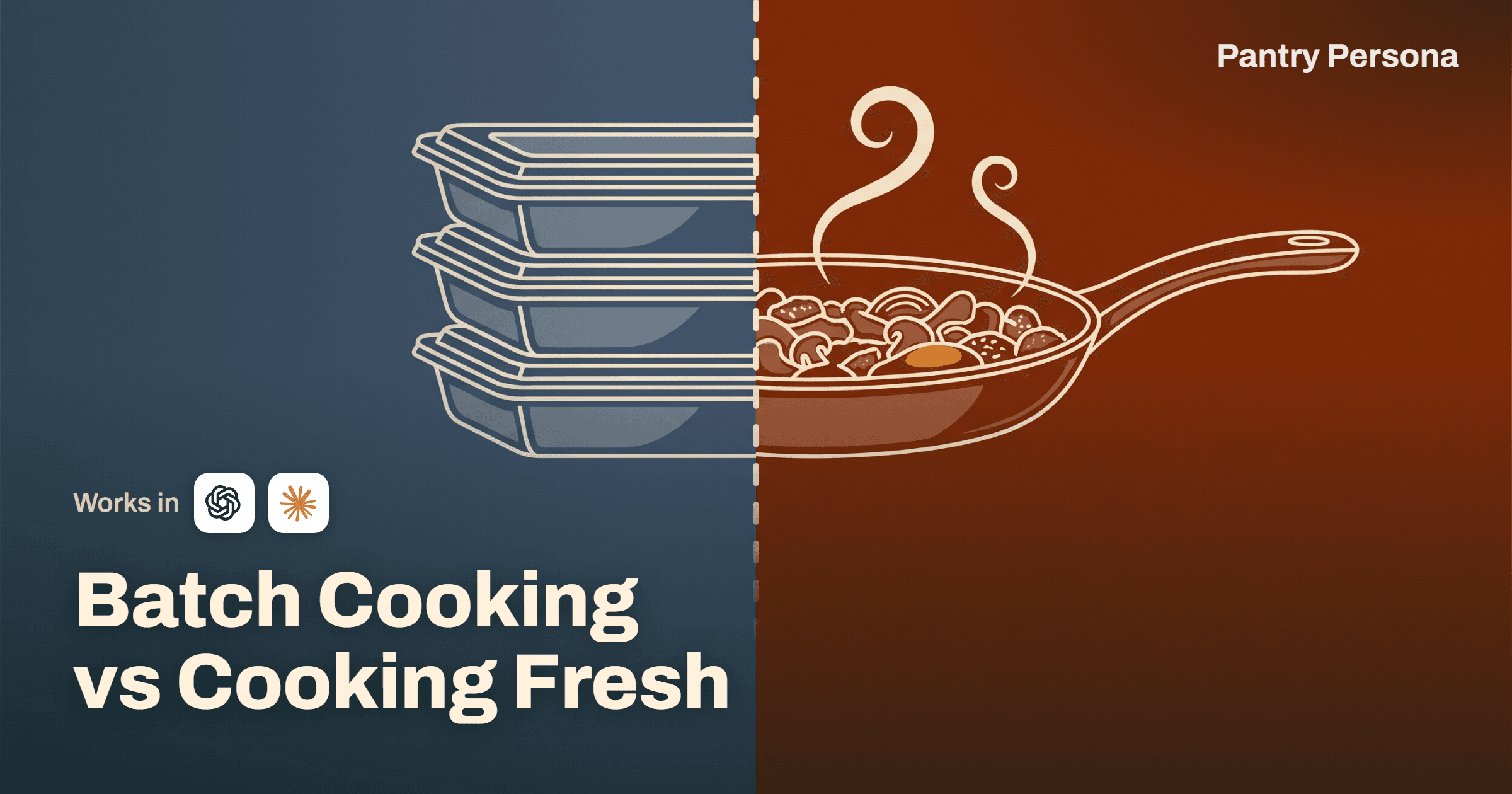
Batch cooking means doing the cooking in advance, usually in one or two sessions, and portioning it for later. Cooking fresh means deciding and cooking close to the meal itself. The food can be identical either way. What changes is where the work sits in the week.
There is a middle setting most people find eventually, usually called component prep: cooking parts instead of meals. A pot of rice, a tray of roasted vegetables, a pound of browned ground beef. None of those is dinner by itself, and all of them take twenty minutes off three different dinners later.
Worth settling before the comparison: the research favors home cooking generally, not any particular schedule. In a cross-sectional analysis of 11,396 adults in the UK Fenland Study, people eating home cooked meals more than five times a week ate about 62g more fruit and 98g more vegetables a day than those eating them fewer than three times a week, and were 28% less likely to have an overweight BMI (Mills et al., 2017). It is observational, so it cannot prove cause, and it says nothing at all about whether the cooking happened on Sunday or on Tuesday.
How do batch cooking and cooking fresh compare?
| Batch cooking (meal prep Sunday) | Cooking fresh most nights | |
|---|---|---|
| Time cost | One block of 2 to 3 hours, plus reheating. Total minutes across the week are often similar; they just sit in one place. | 30 to 50 minutes most nights, spread out. |
| Decision cost | Paid once, on a calm afternoon. Weeknights have little left to decide. | Paid nightly, at the hungriest and least patient hour. |
| Food fatigue | Real by day three or four. The fourth serving of something you liked on Sunday. | Low. Dinner can match the day you actually had. |
| Flexibility | Low. A cancelled plan or an unexpected takeout night leaves food you now have to use fast. | High. Late meeting, sick kid, surprise guest: you adjust that night. |
| The week it fits | Predictable evenings, a free weekend block worth defending, freezer space. | Weeks that change shape by Tuesday, or weeks with no free block to cook in. |
| The house it fits | Households that repeat meals happily. Also one or two eaters, since most recipes already make four servings. | Picky eaters, two or three diets at one table, anyone who eats by appetite. |
What batch cooking is good at
The real win is that the decision is already made. On Wednesday at 6pm there is no question to answer, no ingredient to hunt for, and no 25 minutes of active cooking between you and dinner. For a household with booked evenings, that removes the most fragile point in the week. Doubling a recipe also costs almost nothing extra: the same pot, the same chopping, one cleanup instead of two.
The catches are worth knowing before you spend a Sunday.
The fridge has a hard deadline. Cooked leftovers keep 3 to 4 days refrigerated and 2 to 6 months frozen, per University of Nebraska-Lincoln Extension's food safety guidance, which also says to refrigerate within 2 hours of cooking and reheat to 165°F (UNL Food). So a Sunday session covers Monday, Tuesday, and Wednesday. Cooking once for a full week is a cook-and-freeze plan in practice, and freezing brings containers, space, and labels, which is exactly the upkeep that ends most systems by week three.
Food fatigue arrives on schedule. By the fourth serving, appetite has moved on from the thing that tasted great on Sunday. Households that repeat meals happily are fine here. Households that don't will order takeout on Thursday with a full fridge, which costs more than either rhythm was supposed to.
The Sunday block is its own ask. The person who identifies as their household's usual meal preparer already averages 51 minutes a day on food preparation and cleanup, according to USDA Economic Research Service analysis of the American Time Use Survey's Eating and Health Module (USDA ERS). Asking that same person for two or three consecutive weekend hours on top is a real trade, not a freebie.
It is a bet on the week going as planned. Batch cooking rewards weeks that behave. Every cancelled dinner, unplanned invitation, or kid who suddenly hates rice puts pressure on food with a three-day clock on it.
What cooking fresh is good at
Cooking fresh keeps the food matched to the day. Appetite, weather, who is home, what got eaten at lunch: all of it can still change dinner at 5pm, and less food sits uneaten because it was chosen on Sunday by someone in a different mood. Variety takes care of itself, and for one or two people a fresh dinner is often twenty minutes start to finish.
The costs are quieter, which is why they get underestimated.
The deciding happens five to seven times a week, at the worst possible hour. Choosing dinner does not look like work, so it rarely gets counted as work, and it is still the part most people describe as exhausting. We wrote about that specific hour in the 5pm panic.
It depends on the shopping being right. Fresh cooking with the wrong ingredients in the house turns into takeout faster than anything else here. Batch cooking front-loads that risk into one shop; fresh cooking spreads it across the week.
More cleanup, more often. Five dinners means five sinks. The minutes are small and they land on the tiredest nights.
Which one saves more time?
The total minutes come out close to even: two and a half hours on Sunday against roughly forty minutes a night. The difference is where those minutes sit. They land in a block you chose, on a day you had energy, and the rest of the week has no decision left in it.
For scale, the same time-use survey puts the average US adult at 37 minutes a day on food preparation and cleanup, with usual meal preparers at 51 minutes. A cooking rhythm is competing against a job that already runs about six hours a week.
There is a second-order effect worth weighing too. In a survey of 1,319 adults in the Seattle Obesity Study, people spending more than two hours a day on food preparation and cleanup ate fruit 8.4 times a week against 6.1 for the under-one-hour group, and vegetables 13.6 times against 10.6. The lighter-cooking group was about 1.8 times more likely to visit a quick-service restaurant weekly, and spent roughly $22 per person a week eating out against about $15 (Monsivais et al., 2014). Cross-sectional again, so the direction is unproven. The pattern still travels: kitchen time tends to displace money and meals spent elsewhere, whichever rhythm produced it.
Cooking ahead buys back decisions more than it buys back minutes.
How do I pick between them?
Rank three things about your own week before ranking the methods: how predictable your evenings are, how much variety the table needs, and whether a free block exists that you would actually defend. Then read down this list until one of them sounds like your house.
- Evenings that look roughly the same each week, plus a free weekend block. Batch cooking pays here, and it pays the most on the nights that used to end in a drive-through.
- Evenings that change shape by Tuesday. Cook fresh, and put the effort into keeping the right ingredients in the house instead of into cooked food with a deadline.
- A household that eats the same dinner two nights running without complaint. Batch cooking scales cleanly here.
- Picky eaters, or two or three diets at one table. One big pot rarely fits everyone. Component prep beats full-meal prep here: cook the rice, the protein, and the vegetables separately and assemble differently per person.
- Cooking for one or two. The math flips, because nearly every recipe makes four servings, so batch cooking happens whether you planned it or not. Solo cooking has its own set of rules.
- No freezer room. Three to four days is your hard ceiling. Put the cooked-ahead meals in the front half of the week and leave Thursday and Friday fresh.
The hybrid most households land on
Neither pure rhythm survives a normal week, so most households quietly build a third one.
In practice: cook one thing that reheats well, a chili, a braise, a baked pasta, and eat it Monday and Tuesday. Freeze the remainder in single portions on Sunday instead of pushing it toward Thursday and hoping. Roast a tray of vegetables and cook a pot of grains that can go three different directions. Then leave Thursday and Friday deliberately undecided, because that is when the week usually stops cooperating anyway.
Either rhythm still needs the plan to live somewhere other than one person's head. Inside ChatGPT and Claude, Pantry Persona plans from the recipes you've saved, with each person's allergies and dietary lines filtered out and their dislikes ranked down. It varies the rotation, so the same three dinners don't come around every week, and the ones you cook most often get lifted. When Wednesday falls apart, you can ask it to move that meal to Friday. (The longer version of that is planning a week in one conversation.)
Common questions
How long does batch-cooked food actually last?
Three to four days in the refrigerator, two to six months frozen, using the UNL Extension guidance above. Two practical consequences: get food into the fridge within two hours and in shallow containers so it cools fast, and if a batch is meant for Friday, freeze it on Sunday rather than trusting five days of refrigeration.
Is meal prepping cheaper than cooking every night?
The saving that shows up reliably is fewer takeout nights, not cheaper groceries. The Seattle Obesity Study numbers above put the higher-cooking group about $7 a week per person lower on eating out. Buying in bulk only helps if the bulk gets eaten.
Does batch cooking make food less healthy?
Nothing in the research separates the two rhythms on health outcomes. The research keeps landing on the frequency of home cooking, and both rhythms deliver that. The honest risk with batch cooking is a narrower range of foods, since a week built from three recipes is a week with fewer ingredients in it.
Can batch cooking work with picky eaters?
Full-meal batch cooking rarely survives a picky eater. Components do much better, because the objection usually lands on the assembled dish rather than on plain rice or plain chicken. Cook the parts ahead, assemble at the table, and the same thirty minutes of Sunday work covers three different dinners.
Try one week of each
The fastest way to settle this is to run both. Cook ahead one week, cook fresh the next, and pay attention to the specific night each one broke: the Thursday nobody would touch the chili, or the Tuesday that became cereal because nothing had been decided by 6pm. That night is the one your rhythm has to solve, and knowing which one it is beats any general argument about which method is better.
Whichever way it lands, the night that breaks is a deciding problem before it is a cooking problem. If you already use ChatGPT or Claude, connecting Pantry Persona takes about two minutes. See how it works.